

Now that you’ve committed to having more regular family meals, it’s time to address the big question: How? We’ve helped thousands of families over the years, and if there’s one thing we’ve learned, it’s that wanting to have dinner together and being able to have dinner together are two different things.
In Week One, we shared ideas for finding time to eat together, from quick family breakfasts to making split-shift dinners count. This week, we’re focusing on how to plan, organize, and execute without feeling totally overwhelmed. No five o’clock “what will we eat?” panic, no elaborate hours of meal prep every weekend just to stay on track (unless that’s your thing, in which case, do what works for you!). Just practical suggestions to make the “how” easier, so you can enjoy your time together.
Step One: What’s For Dinner?

In our experience, meal planning is a love-it-or-hate-it exercise. Some people enjoy doing it, or at least feel it pays off enough to make having a plan worth it. Others talk about meal planning the way some of us talk about cleaning under the fridge: Sure, we know we should do it, but will anyone really notice or care if we don’t?
The good news is, you don’t have to love meal planning to get organized for your family meals. The bad news is, you do have to put a little forethought into what you’ll eat, if you want to avoid the evening scramble. An easy starting point might be to answer these basic questions:
- What are three meals everyone in my family eats without complaint?
- What is one meal I can reliably make in under 20 minutes, using ingredients I can keep on hand? (Heating up a frozen meal counts!)
- What is one dish I can make once, then reinvent the leftovers for a second dinner later in the week? (Think: Chili becomes loaded Tex-Mex baked potatoes, roast chicken becomes chicken quesadillas, spaghetti and meatballs become meatball subs…)
- What is my preferred way to handle a no-cooking night? (Takeout, “choose your own adventure” night, delegate to another household member?)
Your answers can not only create at least a week’s worth of dinner ideas for you, but they can also help clarify how you’ll handle things like nights when the schedule doesn’t go as planned, or how you’ll make sure the main cook in the family gets a much-needed night off every once in a while.
For more regular meal planning, there are a lot of different ways to manage your menus, ranging from laid-back to uber-organized. We recommend taking our short, fun personality quiz to learn more about your personal meal planning type!
Now, explore these tools to help with your dinner organization:
- Pantry stock-up lists: Practical and Polished
- Printable Meal Planning and Shopping Worksheet
- Meal Sorting Planner
- 20 No-Fail Dinners
- How to Build a Sheet Pan Meal
- Simple Soups
What About “Picky Eating?”
This is a common question, and so-called “picky eating” can be a major challenge for families. But it’s also worth noting that being selective about food can look very different from person to person. Some children start off eating a wide variety of foods, then narrow their choices for a while before gradually working their way back up to a longer list of things they enjoy. Some seem to have texture or smell aversions from the start, and consistently struggle to try new things. Sometimes selective eating habits stick around all the way into adulthood, or worsen over time. The key is to know whether what you’re seeing is really common “picky eating,” or something else.
It’s absolutely typical for kids to go through phases of food neophobia (not wanting to try new things), food jags (only wanting the same predictable items over and over again), or sudden aversions (claiming they no longer like something they previously ate). Most of the time, those patterns are nothing to worry about. But occasionally, more restrictive, rigid, or worsening changes in diet can be a signal that there’s something else going on. If you’re frustrated or concerned about a family member’s limited diet, we encourage you to check out the following resources. They’ll help you sort out what’s typical, what’s worth a closer look, and how to support kids in developing a healthy relationship to food.
Step Two: Who’s in Charge?
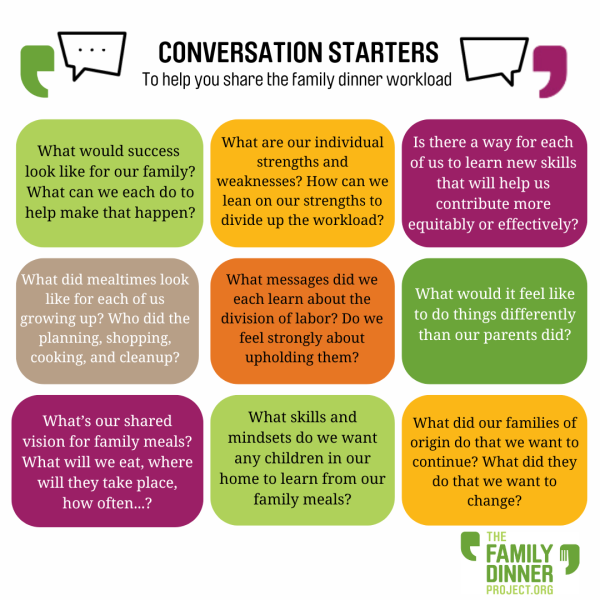
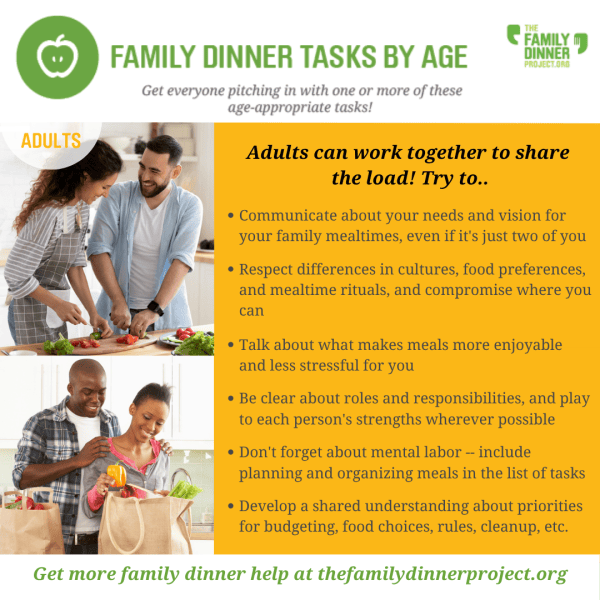
Family meals can feel like a lot of work – both the mental load, and the physical tasks. In many households, the bulk of that work tends to fall to one person, which can be exhausting. That’s why we advocate for families to really examine their division of labor and make conscious, collaborative decisions about distributing the workload in a way that makes sense for everyone. There is no one right answer, but even in homes where one person ends up taking the brunt of the work, there’s a big difference between doing so because you’ve talked about it and agreed that it makes sense, and doing so because that’s what everyone assumes will happen.
Talking about how to share the workload isn’t always easy or comfortable, but for many families, having dinner together more frequently – and with less stress – is more achievable when tasks are split up and shared.
Start the Conversation:
Ask for Help:
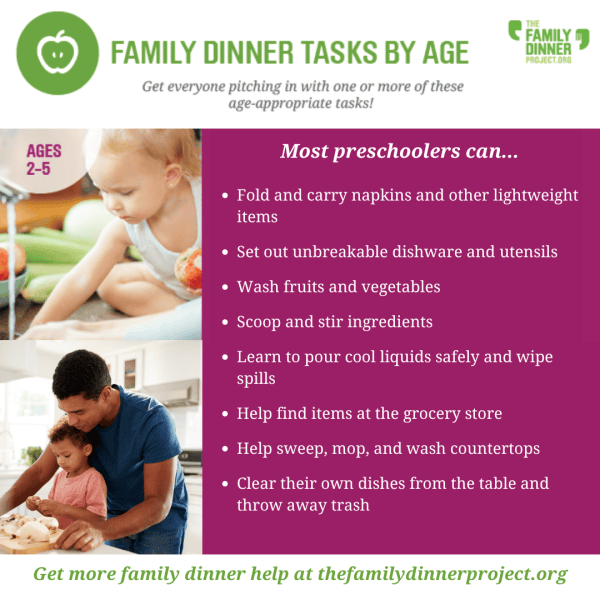
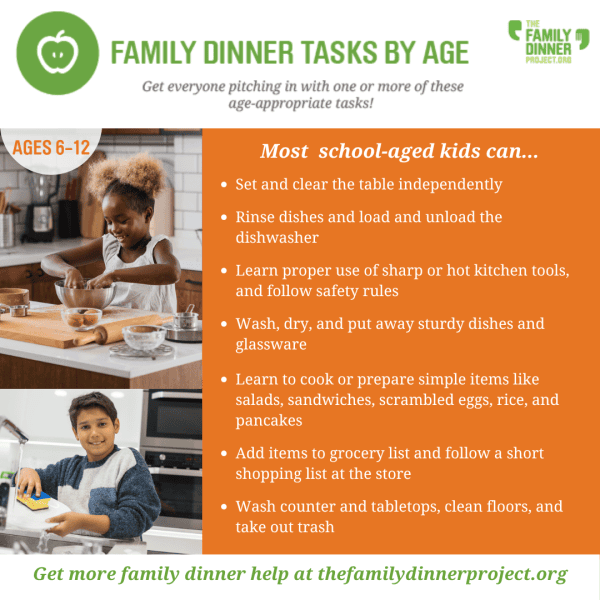
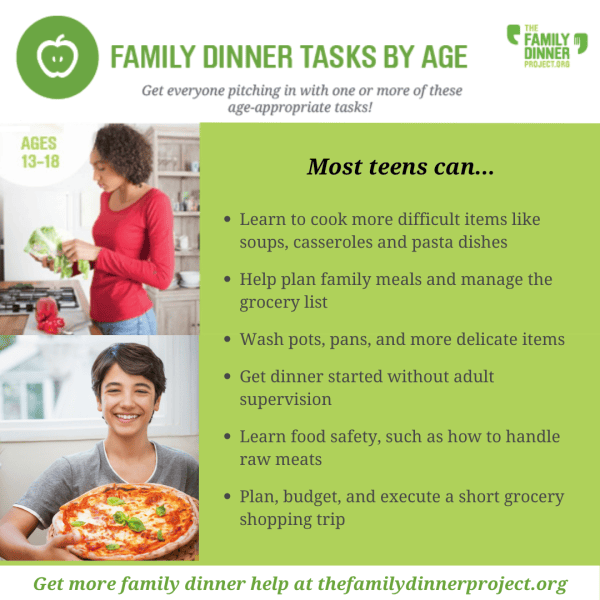
You’d be surprised how much kids can contribute to the family dinner workload! And while, admittedly, it can sometimes feel more stressful to have little ones underfoot, getting children involved in the planning, shopping, cooking, and cleanup teaches important life skills. With a little patience, they’ll learn how to be invaluable helpers in the long run.
Take a look at these age-by-age lists to help you start delegating jobs so everyone has a part to play in making dinner happen, at least some of the time:
Step Three: How’s it Going?

As you ease into new habits and roles, you’ll want to keep checking in with each other about how things are going. How do different family members like the food? How often are you able to stick to whatever plan, however loose, you’ve created for the week? How do all the members of the household feel about the division of labor? You can always adjust as needed, but it’s hard to know what needs tweaking if you aren’t communicating about it.
- What was the best thing we ate this week?
- Was there anything we tried this week that we wouldn’t want to eat again?
- What went really well at dinner? What would we like to do differently?
- Did our plans work out (mostly) as we expected? If not, what happened, and how can we fix it?
- How did each one of us help make family dinner happen this week? How did that go?
Need an easy, constructive way to get kids’ feedback on the meal? Try letting them play food critics! Print out these comment cards and give everyone a chance to fill them out, so they can share their opinions without introducing extra conflict or tension at the table.
Week Two Bonus Content:
- Podcast: Back to School Family Dinners
- Podcast: Family Dinner During May Madness
- Podcast: Labor of Love?
- Expert Interview: How Dads Are Finding New Roles at Dinner
- Tips for Getting Everyone Involved in Dinner
 Introduction
 Make the Commitment
 Make it Work
 Make it Fun
 Make it Matter