

By this point in your family dinner journey, you’ve learned more about the whys and hows of shared meals, and you’ve hopefully started to have some fun making them happen. But we’ve always said that there are three key ingredients to a beneficial family dinner: Food, fun, and conversation about things that matter. So this week, it’s time to focus on that final ingredient.
Talking to one another seems like it should be the easiest part of sharing a meal, but sometimes it can be more frustrating than we expect. Knowing what to talk about, how to ask the right questions to avoid a one-word answer, managing conflict, and keeping the flow going without letting one person monopolize the table are all common challenges that can make dinner conversation awkward.
Of course, not every conversation needs to be deep and meaningful to matter. In our busy, digitally distracted world, just taking a few minutes to pause and speak face-to-face can go a long way! So this week, we’ve got lots of resources and ideas to help you connect and converse at the level that feels right for you – whether that’s a better version of “How was your day?” or in-depth advice for covering the tough topics.
Step One: Get the Conversation Flowing
If you want to have a great conversation, it helps to have a great conversation starter! We’ve got hundreds of them on our conversation page, but we’ve also curated these collections you can keep handy for everyday use. With these conversation starters at the ready, you’ll never get stuck on “How was school?”…”…fine….” again!
Step Two: Deepen the Connection

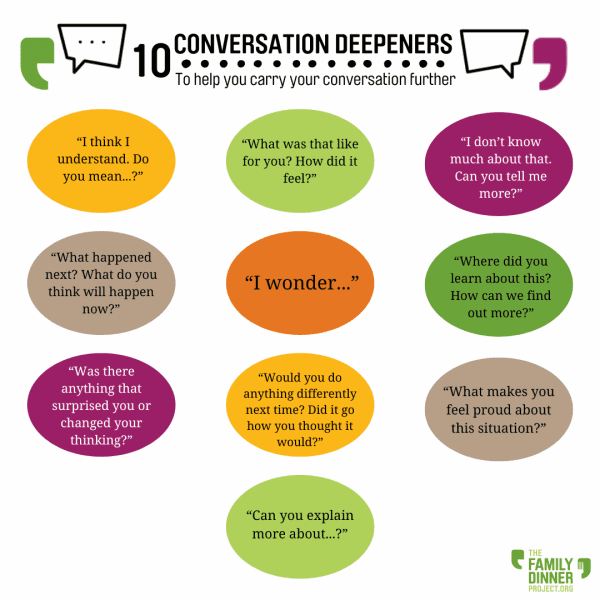
Fun, lighthearted conversations are important. They’re the building blocks of our connection, and a way to build the foundation for deeper relationships. But sometimes families get stuck when they try to move a little bit beyond the easy conversations.
Relationships can be tricky, some family members may not feel like talking, tension may flare, or you may not know exactly how to keep a conversation going without accidentally shutting it down. For all these reasons and more, you may want more tools at your fingertips to help you expand your communication or tackle some tough topics.
- Learn how to avoid one-word answers
- Get perspective on how different responses can either stop or deepen a conversation
- Read our tips for having challenging conversations
- Get tips on initiating more rewarding conversations with your partner
- Gather more tips on creating meaningful conversations with your family
- Check out our Tough Topics archive, with expert advice on talking with your family about subjects like mental health, substance use, sex, and more
Step Three: Share Your Stories
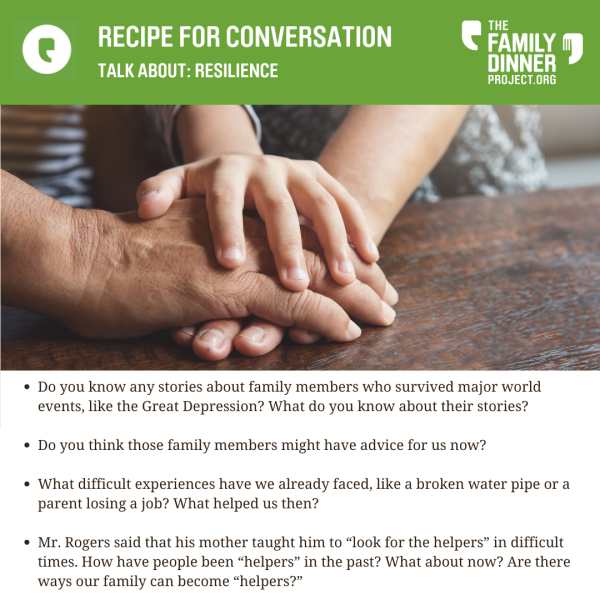
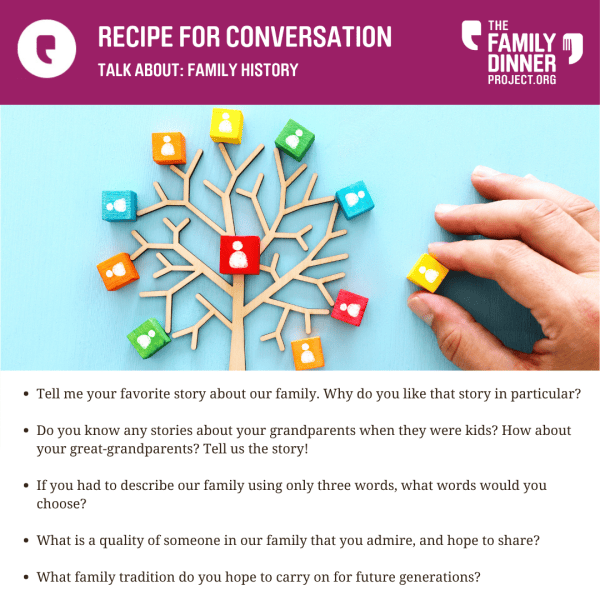
Research has shown that when children know their family histories, they tend to be more resilient. Kids who have a sense of where they belong and where they came from recover more easily from bullying and have greater self esteem. That’s just one of the many reasons why family dinners are important – they can help provide a foundation for identity, and offer a regular opportunity to share stories and memories that keep your family’s history alive.
Where to Start?
- Read more about the resilience-building properties of sharing your family stories
- Set the table for sharing with our printable family interview placemats
- Get fun and creative ideas for movie night with our Dinner and a Movie: Family History experience
- Try some of the conversation sets below!

Step Four: How Did it Go?

Now is a great time to reflect, not just on the conversations you had this week, but on the past four weeks of working to improve your family dinners. Maybe some nights went better than others. Maybe you learned a lot of “what NOT to do” along with some things you’d like to keep doing. But mostly, we hope you experienced food, fun, and conversation in a way that went beyond what you’ve had before. That’s something you can build on.
Remember that as you continue to settle into a routine that works for your family, you’re providing the framework for a lifetime of memories. No, not every meal together will be something you look back on and talk about in decades to come – but every one adds up to a place and a way of being together that will become part of the story of your family. Over the years, some things will change, and your table will shrink and grow at different times. But that’s all part of the beauty of family dinners; they’re always available, wherever, whenever, and whoever shows up. And they can always adapt to the family you are now.
Week Four Bonus Content:
- Read Dr. Anne Fishel’s thoughts on the importance of ritual and routine for families
- Family members who are on the autism spectrum, or who have ADHD, learning disabilities, feeding disorders, or sensory processing issues need family dinner to be a safe and welcoming space. Check out our Welcoming Table resources for expert advice on making dinner easier and more meaningful
- Trying to make dinner matter in more than one household? Check out our tips for family dinner after divorce
- Keep your motivation going with our podcast episode about setting intentions for your family meals
- Get additional inspiration from real families and communities who have improved their shared meals with our Real Family Dinner Projects
 Introduction
 Make the Commitment
 Make it Work
 Make it Fun
 Make it Matter